
A ten year integrated strategy
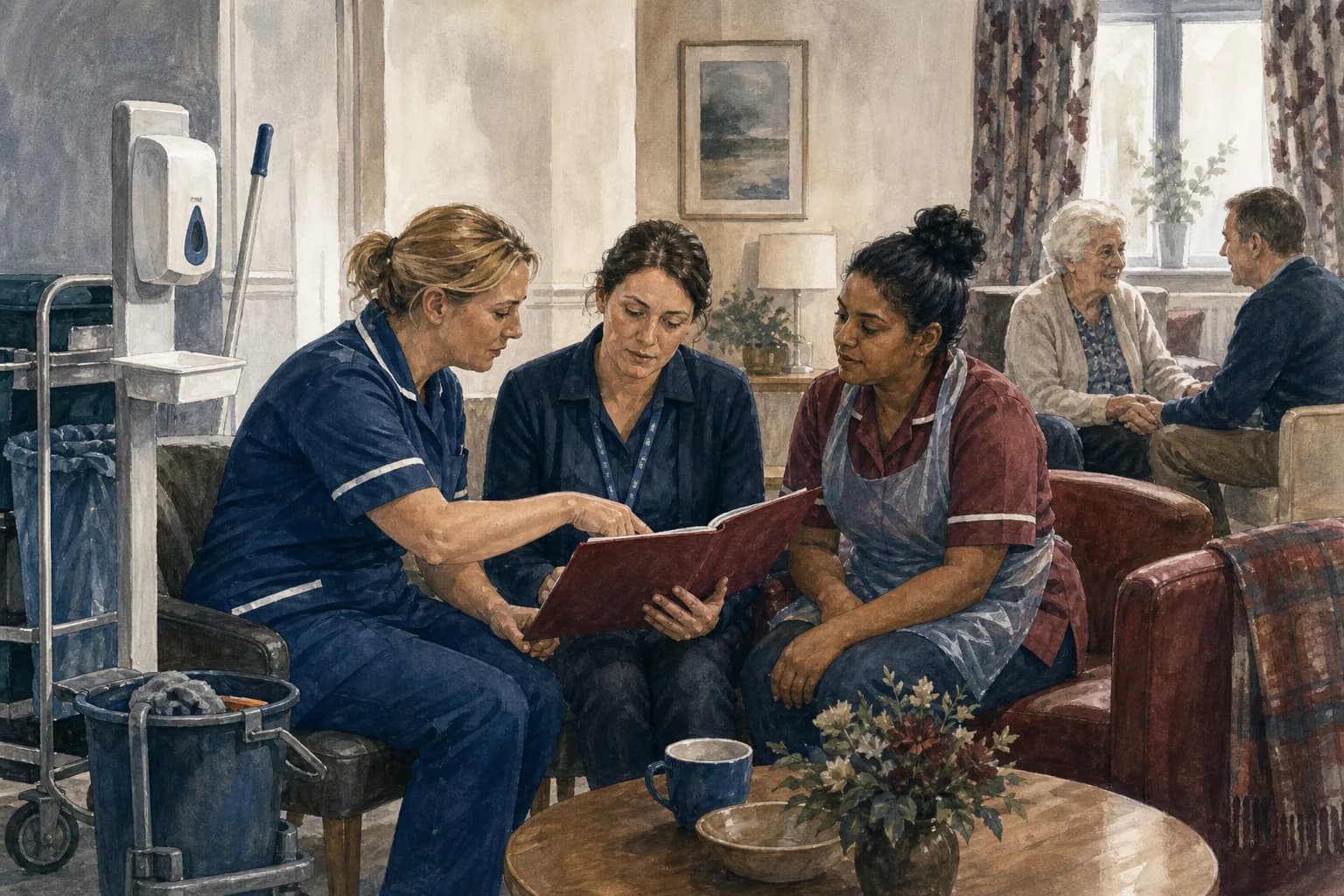
The Scottish Government published a ten year infection prevention and control strategy on 27 July 2026 covering health and social care together. It described the document as the first integrated national strategy of its kind in the UK and said care homes were included explicitly for the first time. The change reflects a basic feature of modern care. People, staff, equipment and information move between hospitals, community services, homes and residential settings, so infection risk does not stop at an organisational boundary. A national framework can align purpose and accountability, although the announcement alone does not alter practice in every service.1
The strategy sets eight priority areas. These include stronger governance and leadership, proactive national and local programmes, better data and surveillance, and wider education, training and career development. Other priorities concern evidence, improvement and the infrastructure needed to sustain infection prevention. They are framed at a high level because implementation will run across different systems and professions. That breadth is useful for coordination but makes subsequent action plans essential. Nursing teams need to know which standards, resources and reporting routes change, who is responsible and when progress will be reviewed.1
Care home inclusion responds directly to lessons from Covid-19, when residents faced high infection risk and measures intended to control transmission sometimes produced isolation and other harm. Social care has distinct staffing, buildings, resident rights and patterns of clinical support. Extending a hospital model without adaptation would not create integration. The strategy needs to recognise the home as a person’s residence as well as a place where care is delivered. Prevention and outbreak decisions must balance infection risk with mobility, contact, autonomy and the harms of restriction.1
The strategy was developed through a national oversight group established in September 2025 with government, NHS boards, academic, social care and third sector participation. Broad membership can improve legitimacy and surface delivery problems early. Representation does not by itself prove that residents, families and front line workers shaped every priority. Action planning should show how those groups remain involved, especially when measures affect visiting, isolation or daily life. Co-production is most valuable when it changes a decision or exposes an assumption, not when it appears only in a list of consultees.1
The scale claimed by government
Government modelling cited in the announcement estimates about 7,500 healthcare associated infections and £46.4 million in annual costs. It says a ten per cent reduction could release 5,800 bed days. These figures communicate the possible scale of preventable harm and capacity, but they are modelled estimates rather than a count of every infection or a guaranteed saving. The result depends on definitions, included settings, attributable costs and assumptions about how fewer infections change length of stay. The full method should be available to those using the figures for investment decisions.1
A released bed day is not automatically a cash saving. Fixed staff and estate costs may remain, while the capacity can instead allow another patient to receive care sooner. That is still a meaningful benefit in a pressured system, but it should be described accurately. Infection prevention may also require spending before benefits appear, including specialist staff, training, surveillance systems and environmental work. Business cases should show both the resource required and the outcomes expected. Treating the £46.4 million estimate as money immediately available would create an unrealistic implementation plan.1
The ten per cent scenario should not become a target detached from baseline quality. A service with strong prevention and low rates may have less avoidable infection than one with recurring outbreaks. Some infections are not preventable even when standards are followed. Comparison requires adjustment for population, exposure and detection. More complete surveillance can initially make performance appear worse because events that were previously hidden become visible. Leaders should reward accurate reporting and improvement rather than create incentives to narrow definitions or delay confirmation.1
Measures should include outcomes that matter in social care as well as hospital utilisation. Resident illness, antimicrobial use, hospital transfer, outbreak duration, staff absence, visiting restrictions and experience all provide information. Data collection must be proportionate for small providers and should return useful intelligence to them. A national system that extracts reports without supplying local feedback will struggle to improve practice. Support for digital records and analysis may be as important as the choice of indicator.1
How current guidance fits
The strategy sits above existing operational guidance. Scotland’s National Infection Prevention and Control Manual sets standard and transmission based precautions for health and care settings, while a care home manual addresses the residential context. Public Health Scotland guidance for acute respiratory infection directs care homes to those manuals and describes when local health protection teams should be involved. Staff should continue to follow current guidance rather than wait for the ten year strategy to produce new documents. Any future change needs clear version control so teams know which instruction is authoritative.2, 3
Standard precautions apply to known and unknown infection risk and include hand hygiene, respiratory practice, personal protective equipment, safe management of equipment, environment, linen, waste and exposure incidents. Transmission based precautions add controls for suspected or confirmed infection. Their effectiveness depends on supply, staffing, space and competence. A policy stored online does not ensure that a worker can access suitable protective equipment during a night shift or isolate safely in a shared environment. Implementation measures need direct observation, staff feedback and prompt correction of barriers.2, 3
Public Health Scotland’s respiratory guidance uses risk assessment and emphasises the least restrictive measures that achieve appropriate protection. It covers care homes and other community or residential settings and recognises that outbreaks differ. That principle is crucial after the pandemic. Blanket restrictions may reduce contact but cause loneliness, distress, deconditioning and difficulty monitoring a resident’s wellbeing. Local health protection advice should consider the organism, severity, setting and vulnerability, while services document how they protected essential relationships and reviewed restrictions.2, 3
The April 2026 guidance defines circumstances in which clusters of respiratory symptoms in higher risk settings should prompt contact with health protection teams. Staff need training to recognise patterns and a route to act outside office hours. Testing availability and recommendations can change by pathogen and period, so old outbreak folders should not be assumed current. Care homes should verify links and contacts during routine preparedness checks. Hospital discharge teams should share relevant risk information lawfully and promptly, avoiding both unsafe transfer and unnecessary delay based on vague concern.2, 3
What implementation requires
Governance needs a line from national policy to each board, partnership and provider. Named leaders should have authority, specialist advice and access to decision makers, while boards receive information that reveals rather than averages away risk. Social care providers vary greatly in size and structure, so support cannot depend on every home employing a full infection prevention team. Regional expertise, care home liaison and accessible advice can provide capacity without removing local responsibility. Commissioning and inspection should align with the same standards to avoid conflicting demands.1, 2
Workforce development must cover permanent, temporary and agency staff across roles. Training should be practical, assessed and repeated when guidance changes. Staff need protected time to learn and enough colleagues to perform precautions without omitting care. Career pathways for infection prevention specialists can improve recruitment and retain expertise, but general nurses and care workers also need confidence to challenge unsafe practice. Education should explain why a measure is used, because rules followed without understanding are more likely to fail when the setting changes.1, 2
Infrastructure includes ventilation, hand hygiene facilities, single rooms where appropriate, cleaning equipment and information systems. Older care homes may face physical constraints that cannot be solved by reminders. Improvement plans should identify capital needs and interim controls, with funding routes that do not penalise residents through unaffordable fees. Ventilation changes need building and clinical expertise. Portable devices should be selected, maintained and positioned on evidence rather than purchased as a visible response. Environmental controls complement vaccination, hygiene and staffing rather than replace them.1, 2
Surveillance must connect data across settings while protecting privacy. A care home needs early warning of a pattern among residents and staff, and hospitals need information relevant to admission and discharge. National analysts need consistent definitions to see regional changes. Data sharing should be limited to what is necessary, with clear legal basis and access. Small numbers can identify individuals, so public reporting may require aggregation. The strategy should specify how information leads to advice, resources or intervention. Collection without a response loop adds burden and may reduce trust.1, 2
How success should be judged
The first test is whether action plans contain dates, owners, resources and measurable results. Broad commitments to collaboration and education are not enough. Government should publish baselines and regular progress, explain delayed work and record changes made after front line feedback. Measures should be stratified so national improvement does not conceal worsening outcomes in care homes or remote areas. Independent review can test whether reported progress is visible in practice. Residents and staff should be able to understand the summary without needing to interpret technical programme language.1, 3, 2
A second test is whether care homes receive tangible support. That includes timely specialist advice, accessible training, outbreak help, surveillance feedback and funding for necessary changes. Providers should not be included in strategy language while remaining outside data and improvement infrastructure. At the same time, national support does not remove provider duties. Services need current policies, supplies, competent staff and incident learning. Inspection findings can identify gaps, but improvement should not wait for an inspector to discover them.1, 3, 2
A third test is whether infection control respects rights and avoids preventable secondary harm. Reviews should consider visiting, isolation duration, mobility, nutrition, mental wellbeing and access to ordinary healthcare. Decisions made during an outbreak need documentation and frequent reassessment. Families should receive clear explanations and a route to raise concerns. The least restrictive effective approach should be evident in practice, not only in guidance. Infection prevention gains achieved through disproportionate isolation would not represent full success.1, 3, 2
The final test is sustained capability. A temporary programme can improve training completion while funding lasts, then lose expertise and data quality. A ten year strategy should establish recurring budgets, workforce pipelines, maintained systems and governance that survives organisational change. It should also adapt as pathogens, evidence and care models change. The strategy’s integrated scope is a meaningful policy development, especially for care homes. Its value will be demonstrated by safer daily care, faster and more proportionate outbreak response, and transparent evidence that improvements reach both health and social care.1, 3, 2
Nursing leaders can translate the national priorities into a small number of local questions. Do staff have the current manual and supplies, can they obtain expert advice, are environmental barriers recorded, and does outbreak review include residents’ rights and experience. They can trace one recent incident from detection through escalation, laboratory or health protection input, communication and learning. The exercise should include care delivered at home and across transfers, not only inpatient areas. Where the trace fails, leaders can assign an action before waiting for a national metric. This practical work connects strategy to care while allowing national programmes to build longer term data, education and infrastructure.1, 3, 2
Public reporting should also acknowledge uncertainty. Infection counts depend on testing and surveillance, cost estimates depend on assumptions and comparisons can be distorted by different populations. Publishing methods and revisions increases trust rather than weakening the case for prevention. Residents and families can understand that no system prevents every infection while still expecting avoidable risks to be controlled. The strategy should support honest communication during outbreaks, including what is known, what remains uncertain and when decisions will be reviewed. That standard of explanation is part of integrated infection control because cooperation depends on people believing that measures are necessary, proportionate and open to challenge.1, 3, 2
Learning should cross organisational boundaries after an outbreak or near miss. A hospital, care home, general practice and health protection team may each hold only part of the sequence. A proportionate joint review can identify delayed information, unclear responsibility or effective action worth spreading. It should avoid assigning blame before the evidence is assembled and should include the people delivering and receiving care. Findings need a route into training, procurement and building decisions. Otherwise the same transfer or environmental failure can recur in another service even though the first organisation marked its local action complete.1, 3, 2

Comments
Loading published comments
Preparing the comment form